But Then It Will Be Too Late—Israel and Gaza Today

KODAK Digital Still Camera

Recently the U.S. Ambassador to Israel, Mike Huckabee, commissioned over a thousand pastors “to stand with Israel and combat antisemitism.” CBN quoted Johnnie Moore as saying that this was “the largest group of pastors at one time that has ever come to Israel, specifically for one purpose: to stand in solidarity with the Jewish state and the people of Israel.” (See the CBN report from which these quotations come at http://www1.cbn.com/cbnnews/israel/2025/december/huckabee-commissions-1-000-pastor-army-at-ambassadors-summit-to-stand-with-israel )

According to CBN, Huckabee downplayed the political dimension of this event by telling the pastors that they were ambassadors “for Christ, His Kingdom, and His word.” It appears, however, that, for Huckabee, being an ambassador “for Christ” means that one stands “in solidarity with the Jewish state” (emphases added). Such solidarity has political implications.

I have two serious concerns. First, this event as reported by CBN promotes a false definition of “antisemitism.” The way this event was presented suggests that unless one stands in solidarity with the Jewish state and approves whatever that state does one is antisemitic. This, of course, is palpable nonsense. There is no state in the world that has always acted justly. The Old Testament prophets had no hesitation in pronouncing judgment on ancient Israel. Jeremiah is representative when he condemns Israel because its leaders have “eyes and heart only . . . for shedding innocent blood, and for practicing oppression and violence” (Jeremiah 22:17).

Second, in the present context solidarity with the Jewish state is almost a euphemism for support for the devastation that Israel has brought on Gaza. It is reported that in the first year of the war 42,000 people were killed, including 17,000 children, 100,000 were injured, and 900 families were entirely wiped out. More than half of Gaza’s homes were destroyed, 80% of commercial buildings, 87% of schools, 68% of roads, and 68% of farmland. Almost the entire population—1.9 million—were displaced. (See the sources for these figures in Munther Isaac, Christ in the Rubble: Faith, the Bible, and the Genocide in Gaza [Grand Rapids: Eerdmans, 2025], 14–15.) 

I wince every time I hear people blithely dismiss these figures as inaccurate or justify this slaughter as necessary for Israel’s defense. Can anyone honestly deny the enormous destruction and loss of innocent life in Gaza? Can we be so flippant about human life? Would we talk this way if it were our family members who were being killed? Can you imagine Jesus justifying such wanton destruction? 

Is this slaughter nothing more than “defense”? Listen to Netanyahu’s own words: “We will take mighty vengeance for this black day [Oct 7, 2023] . . . . We will take revenge for all the young people who lost their lives. We will target all of Hamas’s positions. We will turn Gaza into a deserted island. To the citizens of Gaza, I say: You must leave now. We will target each and every corner of the strip” (emphases added). But Israel (and Egypt) made sure that the citizens of Gaza could not leave. Is this defense—or vengeance? (Isaac, Christ in the Rubble, 23.)

The words of Yoav Gallant, Israel’s defense minister, accord well with those of the Prime Minister: “I have ordered a complete siege on the Gaza Strip. There will be no electricity, no food, no fuel, everything is closed . . . . We are fighting human animals and we are acting accordingly.” (Emanuel Fabian, “Defense Minister Announces ‘Complete Siege’ of Gaza: No Power, Food or Fuel,” Times of Israel, October 9m 2923, https://tinyurl.com/4utv9fy5)

Raz Seagal is an associate professor at Stockton University specializing in Holocaust and genocide studies. He writes in the journal Jewish Currents, “Indeed, Israel’s genocidal assault on Gaza is quite explicit, open, and unashamed, Perpetrators of genocide usually do not express their intentions so clearly, though there are exceptions. . . . Galant’s orders on October 9th were no less explicit. Israel’s goal is to destroy the Palestinians of Gaza. And those of us watching around the world are derelict in our responsibility to prevent them from doing so” (emphases added). See Seagal’s “A Textbook Case of Genocide,” Jewish Currents, October 13, 2023 (http://tinyurl.com/32pum2n5).

Even Amos Goldberg, who is at the Hebrew University in Israel and who specializes in Holocaust and genocide research, admits that the destruction of Gaza is genocide: “Yes, it is genocide. It is so difficult and painful to admit it, but despite all that, and despite all our efforts to think otherwise, after six months of brutal war we can no longer avoid this conclusion. (Amos Goldberg [translated by Sol Salbe], “Yes, It Is Genocide,” The Palestine Project, April 18, 2024, https://tinyurl.com/43vuddw3. For the original article in Hebrew click on https://tinyurl.com/3u9hj5jh .)

In the light of these realities can we say with integrity that the destruction of Gaza is nothing more than “defense”? Haven’t the Israeli authorities made it clear that they intend to remove the people of Gaza? Are not their actions in accord with the present Israeli government’s stated intention of incorporating virtually all of Palestine into the State of Israel?  Could they do this without the support of the US and other western governments? Should not we Christians who have approved this wanton slaughter of human life fall on our faces before God in repentance?

Perhaps this short blog post has not convinced you. I challenge you to read Palestinian pastor Munther Isaac’s book mentioned above, Christ in the Rubble: Faith, the Bible, and the Genocide in Gaza. The statistics and quotations in this blog (along with much else) can be found in his book. Ignorance is no excuse when the truth is readily available. There is another book about Gaza that I cannot yet recommend because I have not yet read it. Its title, however, is striking: One Day, Everyone Will Have Always Been Against This (by Omar El Akkad)—but then it will be too late!

God’s Design: The Human Story (Genesis 2:3–25)

This is a recording of the Sunday School lesson given in the Beginnings Class, Clinton Methodist Church, Sunday, June 23, 2024. It is the second lesson in a series on the opening chapters of Genesis. It is being made available here especially for members of the class who were absent. Of course anyone is welcome to listen! I’ve also attache a pdf copy of the handout we used in class for your convenience.

Episode #5: “THE END GAME” Hebrews 12:1–4

Last Wednesday, Sept 29, 2022, I had the privilege of speaking in the chapel service in Hughes Auditorium of Asbury University.

The title was “Episode #5: “The End Game” Hebrews 12:1–4. “

“And let us run with perseverance the race marked out for us, fixing our eyes on Jesus” (Heb 12:1b–2a).

In the words of Kate Wilkinson’s hymn, “May the Mind of Christ My Savior” (an old Asbury favorite): “May I run the race before me, Strong and brave to face the foe, Looking only unto Jesus As I onward go.”

Click here to go to the page where you can view this chapel session by live stream or listen as a podcast. https://www.asbury.edu/podcasts/102396/

Click here to go directly to the podcast. https://www.asbury.edu/wp-content/uploads/2022/09/2022.09.28_Chapel_GCockerill.mp3

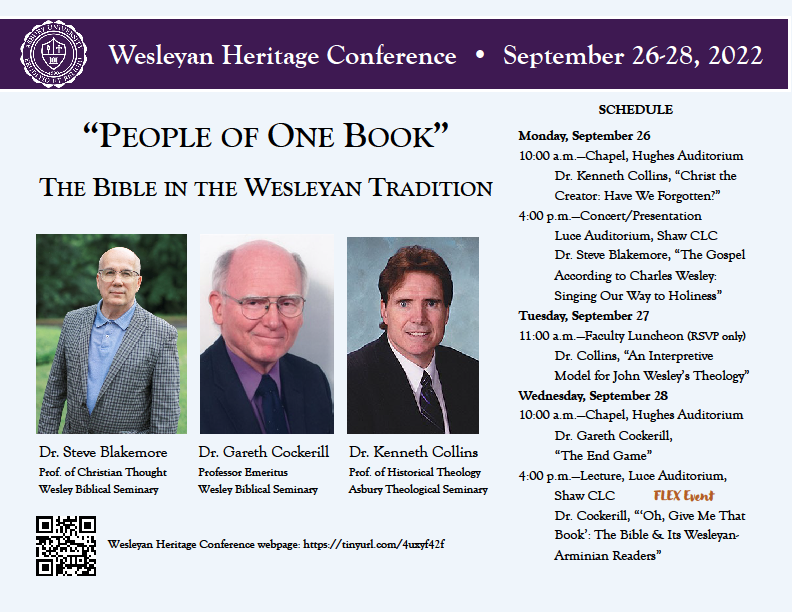
“People of One Book” the Bible in the Wesleyan Tradition.

“‘Oh, Give Me that Book’: The Bible and its Wesleyan–Arminian Readers”

I’m delighted to have the opportunity of participating this week in the conference noted above. My lecture, “ ‘Oh, Give Me That Book’: The Bible and its Wesleyan–Arminian Readers,” argues that the best biblical interpretation incorporates both the Reformation heritage of thorough engagement with the biblical text and Wesley’s concern for salvation, for the impact of Scripture in life. I outline a method of studying Scripture that prioritizes context. It encourages the interpreter to strive for a grasp of the Bible’s unity. Then it begins by moving from a passage’s place in the book where it occurs, to the plan or structure of the passage, and then to the meaning of the words and phrases of the passage. It concludes with a summary of the passages interpretation. 

After Inerrancy: the Wesleyan Theological Journal, 1978-2005

In the above lecture I refer to a paper I gave in the Wesleyan Study Group of the Evangelical Theological Society in 2008, entitled “After Inerrancy: the Wesleyan Theological Journal, 1978-2005.” I’ve wanted to make this unpublished paper available, so I’ve uploaded it here. 

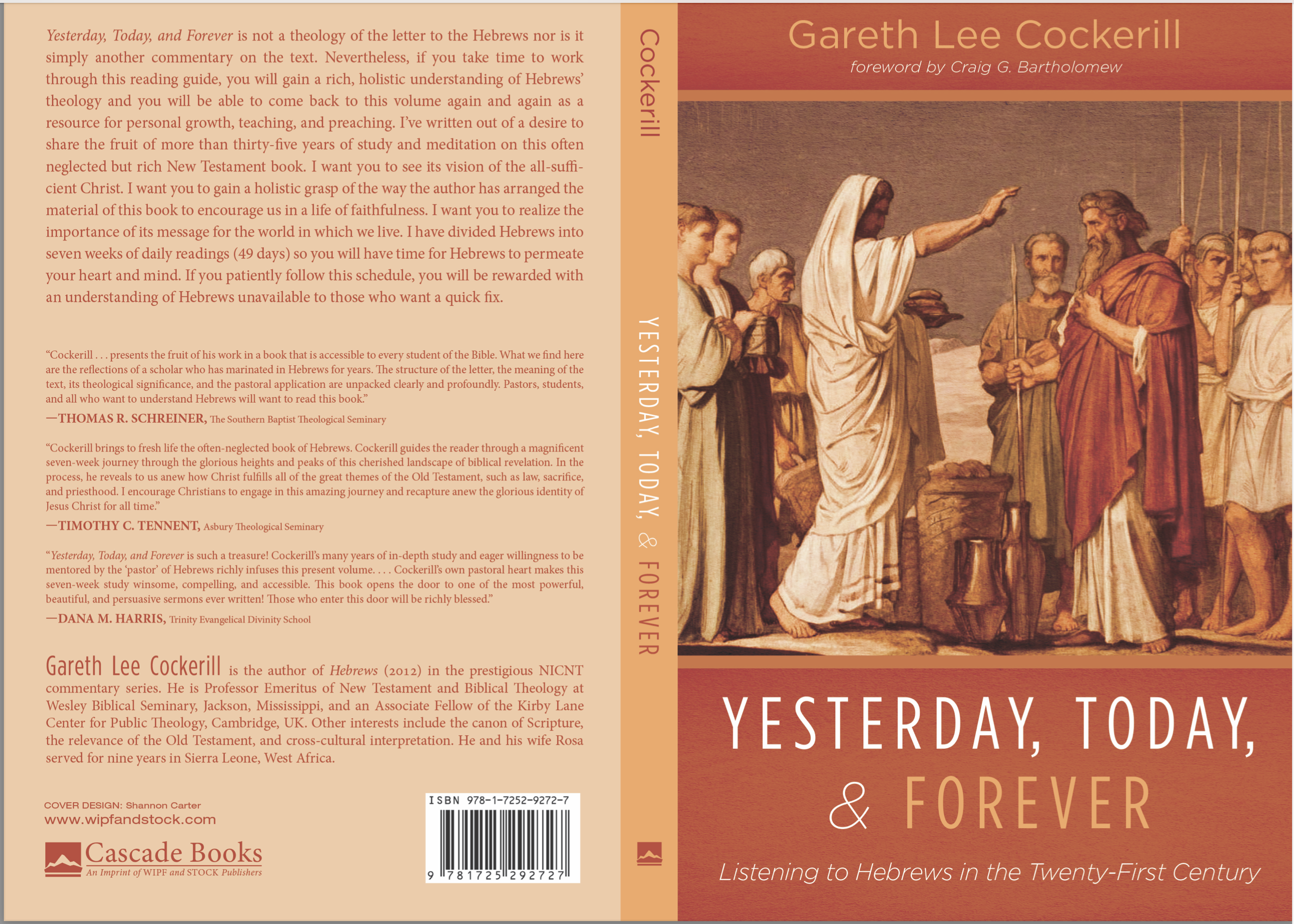
Yesterday, Today, and Forever

From the Back Cover:

If you take time to work through this reading guide, you will gain a rich, holistic understanding of Hebrews’ theology and you will be able to come back to this volume again and again as a resource for personal growth, teaching, and preaching. . . . The book of Hebrews has been divided into seven weeks of daily readings (forty-nine days), so you will have time for Hebrews to permeated your heart and mind. If you patiently follow this schedule, you will be rewarded with an understanding of Hebrews unavailable to those who want a quick fix.

From the Forward:

“Gareth’s book is a marvelous resource as we listen to the, at times, complex letter of Hebrews. . . .I envision it sitting amongst several commentaries on Hebrews, and being the first port of call when the pastor—or student, seminarian, or scholar—is working away on this marvelous book, full as it is of Jesus.”

—Rev. Dr. Craig G. Bartholomew, director of the Kirby Laing Centre for Public Theology, Cambridge, UK

What Others are Saying:

Gareth Cockerill . . . . brings to fresh life the often-neglected book of Hebrews.  Like a seasoned Sherpa, Cockerill guides the reader [on] a magnificent seven-week journey through the glorious heights and peaks of this cherished landscape of biblical revelation . . . .  I encourage Christians to engage in this amazing journey and recapture anew the glorious identity of Jesus Christ for all time. 

—Timothy C. Tennent, PhD, President and Professor of World Christianity, Asbury Theological Seminary

Gary Cockerill has already written one of the best commentaries on Hebrews, and now he presents the fruit of his work in a book that is accessible to every student of the Bible. . . . What we find here are the reflections of a scholar who has marinated in Hebrews for years. The structure of the letter, the meaning of the text, its theological significance, and the pastoral application are unpacked clearly and profoundly. Pastors, students, and all who want to understand Hebrews will want to read this book. 

—Thomas R. Schreiner, James Buchanan Harrison Professor of New Testament Interpretation and Associate Dean, The Southern Baptist Theological Seminary

. . . . [Gary Cockerill’s] many years of in-depth study and his eager willingness to be mentored by the “pastor” of Hebrews richly infuses this present volume. There are deep theological insights on every page! Cockerill’s own pastoral heart makes this seven-week study winsome, compelling, and accessible. I highly recommend this book. It opens the door to one of the most powerful, beautiful, and persuasive sermons ever written! Those who enter this door will be richly blessed. 

—Dana M. Harris, Professor of New Testament, Trinity Evangelical Divinity School

“The grandeur and beauty of the book of Hebrews are only matched by its avoidance and near ignorance in the church. . . . This beautiful, timely book is what the church needs!”

—Scot McKnight, Northern Seminary

“A leading Hebrews scholar takes us step by step through the book. Through its pastoral teaching, we can be shaped and formed into adult Christians. Highly recommended!”

—Thomas A. Noble, Nazarene Theological Seminary

Dr. Cockerill’s work here is accessible to a wide range of contexts and audiences. Whether used in personal devotions, textbook for a class, or study in the local church, the Holy Spirit will use this book to form believers into greater likeness to God through our “all sufficient High Priest who ‘remains forever.’”  

—Christopher T. Bounds, Indiana Wesleyan University     

“Readers will find their knowledge and experience of God in Christ strengthened and deepened.”

—Matt O’Reilly, Wesley Biblical Seminary

 “In this reading guide, Cockerill has masterfully and passionately showcased the crown jewels discovered during his lifetime of exploration in the book of Hebrews.. . . .This is a journey not to be missed, and never to be forgotten!”

—Richard M. Davidson, Andrews University

Have a look at the introduction here:

#Hebrews, #YesterdayTodayandForever, #HebrewsCockerill

No Choice But to Choose. Mark 11:1-26. Podcast #12 in the Series “A Short Course in Following Jesus: Studies in the Gospel of Mark.

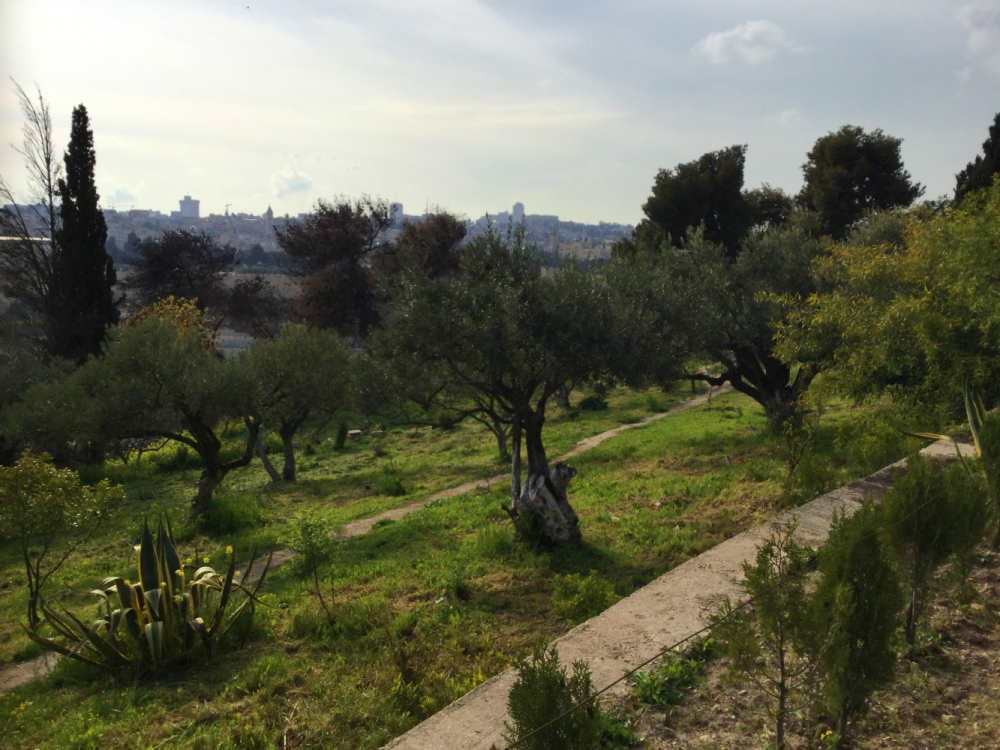
The Mount of Olives

Jesus and His disciples have arrived in Jerusalem. Will the events about to take place awaken the disciples from their denial of His coming crucifixion? What did it mean when Jesus cleansed the Temple? Was He more than a reformer? Listen to today’s podcast below:

Podcast #12 No Choice But to Choose. Mark 11:1-26.

For the earlier podcasts in this series, click here.

“And Followed Him on the Way.” Mark 10:32-52. Podcast #11 in the Series “A Short Course in Following Jesus: Studies in the Gospel of Mark.”

Synagogue at Capernaum

The disciples are in denial as Jesus approaches Jerusalem on his journey to the Cross. Only the crucified and resorted Jesus will be able to awaken them to reality. But there is one person that gets it. Blind Bartemaeus. He acknowledges Jesus as the Messiah and follows Him “on the way” to the cross. Listen to podcast #11 in this series by clicking below.

“And Followed Him on the Way.” Mark 10:32-52

For podcasts ##1-10 in this series, click here: